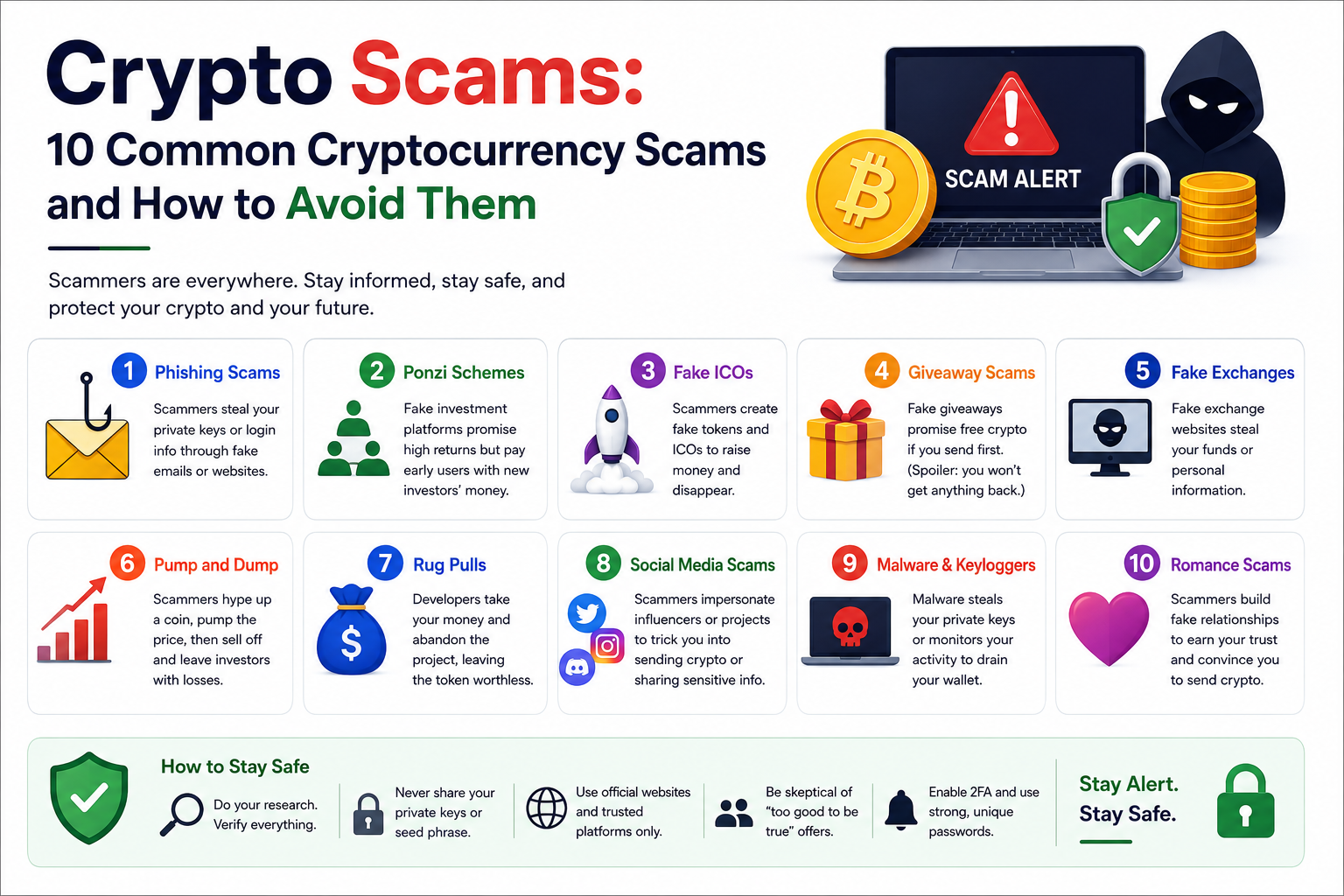
Crypto Scams: 10 Common Cryptocurrency Scams and How to Avoid Them
Cryptocurrency can provide useful opportunities for learning, investing, transferring digital assets and earning rewards. However, the growing popularity of crypto has also attracted scammers.
Crypto scams can target beginners and experienced users alike. Some scams are easy to recognize, while others can look like legitimate websites, investment opportunities, wallets or support services.
The good news is that learning the most common warning signs can help you avoid many scams.
This guide explains common cryptocurrency scams and practical ways to protect yourself.
Why Are Crypto Scams Common?
Cryptocurrency transactions can be fast and, depending on the blockchain, difficult or impossible to reverse.
Scammers take advantage of this.
They may try to convince someone to:
Send cryptocurrency
Share a recovery phrase
Reveal a private key
Connect a wallet to a malicious website
Download fake software
Pay a fake fee
Invest in a fraudulent project
Once funds are transferred to a scammer, recovering them can be extremely difficult.
This is why prevention is one of the most important parts of crypto security.
1. Fake Crypto Giveaways
Fake giveaways are one of the simplest cryptocurrency scams.
A scammer may claim that a famous person, company or crypto project is giving away cryptocurrency.
The scam may say:
"Send 0.1 BTC and receive 0.2 BTC back."
This is a major warning sign.
Legitimate cryptocurrency services do not normally require you to send cryptocurrency first in order to receive a guaranteed larger amount in return.
If an offer sounds too good to be true, stop and investigate before sending anything.
2. Phishing Scams
Phishing scams attempt to steal sensitive information by pretending to be a legitimate service.
A scammer may send an email, message or website link that looks similar to a real cryptocurrency platform.
The fake website may ask you to enter:
Email
Password
Wallet information
Private key
Recovery phrase
Authentication code
Always check the website address carefully.
Avoid opening important crypto accounts through links received in unexpected messages.
Instead, access the service using an official website or trusted application.
3. Fake Crypto Support
Another common scam involves fake customer support.
You may see someone claiming to represent a cryptocurrency company or wallet provider.
They might say:
"Your account has a problem. Send your recovery phrase so we can fix it."
Do not provide it.
Your recovery phrase should remain private.
If you need support, find the company's official support channel independently rather than relying on a random person contacting you.
4. Fake Investment Platforms
Some scammers create professional-looking websites that claim to provide cryptocurrency investment services.
The website may show:
Large profits
Fake account balances
Fake trading history
Fake withdrawal confirmations
Special investment packages
Initially, the platform may even allow a small withdrawal to gain your trust.
Later, the scammer may demand additional money for:
Taxes
Verification
Processing
Account activation
Withdrawal fees
These demands can continue indefinitely.
Never assume a website is legitimate simply because it has a professional design.
Research the company independently before depositing money.
5. Romance and Relationship Crypto Scams
In some scams, criminals build an online relationship with a victim before introducing cryptocurrency.
The scammer may eventually claim that they have a profitable crypto opportunity or need financial help.
They may encourage the person to send cryptocurrency or invest through a website they control.
Be extremely cautious if someone you met online suddenly asks you to send crypto or invest money.
A personal relationship should never be used as a reason to ignore basic financial safety.
6. Fake Crypto Apps and Wallets
Scammers can create applications that look similar to legitimate crypto wallets or exchanges.
A fake application may attempt to steal passwords, private keys or recovery phrases.
Before installing a wallet:
Verify the developer
Check the official website
Review the app carefully
Avoid suspicious download links
Check that the application is from the legitimate source
Do not trust an application simply because it has many downloads or positive-looking reviews.
7. Malicious Airdrops
Airdrops can be legitimate promotional activities used by cryptocurrency projects.
However, scammers can also use fake airdrops to trick users into connecting wallets to malicious websites.
A website may claim:
"Connect your wallet to claim free tokens."
Connecting a wallet to an unknown application can create security risks.
Before interacting with an airdrop, research the project and verify the official announcement through trusted channels.
Never provide your private key or recovery phrase to claim an airdrop.
8. Fake Crypto Mining Opportunities
Some websites promise guaranteed income from cryptocurrency mining.
They may advertise:
Guaranteed daily returns
Free mining
High passive income
Cloud mining packages
Referral bonuses
Not every mining service is fraudulent, but guaranteed returns should immediately make you cautious.
Research the company, its business model and its reputation before sending money.
9. Pump-and-Dump Schemes
In a pump-and-dump scheme, people may promote a cryptocurrency aggressively to push its price higher.
New buyers enter because they believe the price will continue rising.
The people who accumulated the asset earlier may then sell their holdings.
The price can fall sharply, leaving later buyers with significant losses.
Be cautious when someone claims that a cryptocurrency is guaranteed to "explode" soon.
Hype is not the same as reliable information.
10. Fake Crypto Jobs and Tasks
Some scammers advertise simple online jobs involving cryptocurrency.
They may ask you to:
Deposit crypto
Pay an activation fee
Buy cryptocurrency first
Complete fake tasks
Invite people before withdrawing earnings
A legitimate employer should not require you to send cryptocurrency simply to receive your salary.
If a job requires an upfront payment before you can access your supposed earnings, investigate carefully.
Warning Signs of a Crypto Scam
Although scams can look different, many share similar warning signs.
Be careful when you see:
Guaranteed Profits
No legitimate investment can guarantee a specific cryptocurrency profit.
Urgent Pressure
Scammers often say:
"Act now."
"Only 10 minutes left."
"Send the payment immediately."
Urgency is often used to stop people from thinking carefully.
Requests for Your Recovery Phrase
Never share your recovery phrase.
Unexpected Messages
Be cautious about unsolicited messages offering investments, giveaways or account assistance.
Unrealistic Returns
Promises of extremely high returns with little or no risk are a major warning sign.
Upfront Fees
Be cautious if you are asked to pay money before receiving supposed profits, rewards or withdrawals.
How to Protect Your Cryptocurrency
You can reduce your risk by following some simple security practices.
Use Strong Account Security
Use unique passwords and enable additional security features where available.
Protect Your Recovery Phrase
Keep your recovery phrase private and store it securely.
Never save sensitive wallet information in publicly accessible locations.
Verify Website Addresses
Before entering login information, carefully check the website address.
Scammers may use domains that look almost identical to legitimate services.
Do Your Own Research
Do not invest simply because a person on social media recommends something.
Research the project, company and platform independently.
Start Small
If you are testing a new platform or wallet, consider starting with a small amount rather than transferring everything at once.
Double-Check Transactions
Before sending cryptocurrency, carefully verify:
Address
Network
Amount
Transaction fee
Once confirmed, blockchain transactions may not be reversible.
What Should You Do If You Think You Found a Scam?
If something looks suspicious, stop before sending money.
Do not continue communicating with the scammer unnecessarily.
If you already entered your password on a suspicious website, change the password from the legitimate service and review your account security.
If you connected a wallet to a suspicious application, review the wallet's security options and consider seeking help from a trusted security resource.
If cryptocurrency has already been sent, save all relevant information, including:
Transaction ID
Wallet addresses
Website address
Messages
Emails
Payment information
This information may be useful when reporting the incident.
Final Thoughts
Crypto scams can look convincing, but many of them rely on the same basic tricks: urgency, unrealistic profits, fake support, fake websites and requests for sensitive information.
The most important rule is simple:
Never send cryptocurrency just because someone promises you more money in return.
Protect your passwords and recovery phrase, verify websites carefully, research platforms before using them, and take your time before making financial decisions.
A few minutes of research can sometimes prevent a very expensive mistake.