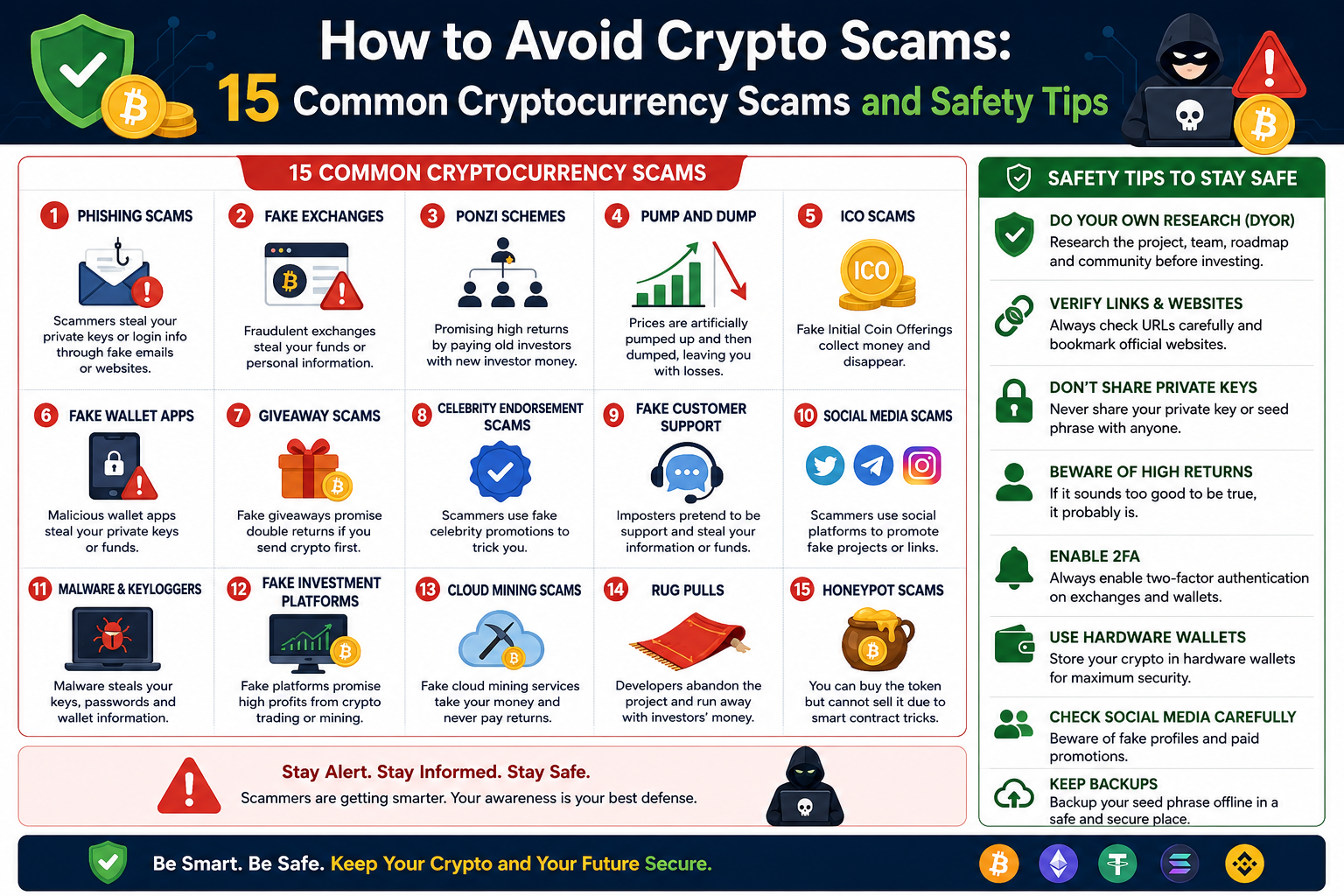
How to Avoid Crypto Scams: 15 Common Cryptocurrency Scams and Safety Tips
Cryptocurrency can provide useful opportunities, but it also attracts scammers. Fake websites, investment promises, phishing messages and fraudulent giveaways can trick both beginners and experienced users.
The good news is that many scams have warning signs. Learning how to recognize them can help you protect your wallet, personal information and cryptocurrency.
### Why Are Crypto Scams Common?
Cryptocurrency transactions can be fast and, in many cases, difficult to reverse.
Scammers take advantage of this by creating a sense of urgency and convincing people to send cryptocurrency before they have time to verify the offer.
Anyone can become a target, so basic security knowledge is important.
## 1. Fake Crypto Giveaways
A scammer may promise free cryptocurrency if you send a small amount first.
For example, a message may claim that sending 0.01 BTC will result in receiving 0.02 BTC back.
This is a common warning sign.
Legitimate platforms do not normally require you to send cryptocurrency first in order to receive a guaranteed larger amount back.
## 2. Fake Investment Opportunities
Some websites promise extremely high or guaranteed crypto returns.
Be careful with claims such as:
* Guaranteed daily profit
* Risk-free cryptocurrency investment
* Double your crypto quickly
* Guaranteed monthly returns
Real investments involve risk. A guaranteed high return should be treated with extreme caution.
## 3. Phishing Websites
Phishing websites are designed to look like legitimate cryptocurrency services.
A fake website may ask you to enter your login details, wallet information or recovery phrase.
Always check the website address carefully and use official sources when accessing your wallet or account.
## 4. Fake Wallet Applications
Scammers may create applications or browser extensions that look like popular crypto wallets.
Downloading a fake wallet can expose your private information or cryptocurrency.
Before installing a wallet, verify its official website and download source.
## 5. Fake Customer Support
Scammers sometimes pretend to be customer-support representatives.
They may contact users through social media, messaging apps or comments and claim that an account has a problem.
They may then ask for:
* Recovery phrase
* Private key
* Password
* Security code
* Wallet access
Never give your recovery phrase or private key to someone claiming to be support.
## 6. Fake Airdrops
Crypto airdrops can be legitimate, but scammers also use fake airdrops to collect wallet information.
A suspicious airdrop may ask you to connect your wallet to an unknown website or sign an unexpected transaction.
Always verify the project through trusted official channels before interacting with an airdrop.
## 7. Romance and Social Media Scams
Scammers can build relationships with victims before introducing a cryptocurrency investment opportunity.
They may promise to help you make money or show fake trading results.
Never send cryptocurrency simply because someone online claims to care about you or promises financial success.
## 8. Fake Mining Opportunities
Some websites advertise cryptocurrency mining contracts or cloud-mining plans with guaranteed profits.
Before paying for a mining service, research the company carefully and understand the risks.
A professional-looking website does not automatically mean that a service is legitimate.
## 9. Fake Jobs That Require Crypto Payments
Be careful if someone offers you a job but asks you to pay cryptocurrency for:
* Registration
* Training
* Equipment
* Account activation
* Withdrawal processing
A request for cryptocurrency payment before receiving promised employment should be treated as a major warning sign.
## 10. Fake Crypto Faucets
Not every website offering free cryptocurrency is legitimate.
A suspicious faucet may promise unrealistic rewards, require unnecessary payments or request sensitive wallet information.
Before using a faucet, check its reputation and never provide your private key or recovery phrase.
## 11. Impersonation Scams
Scammers may pretend to be famous crypto developers, companies, influencers or platform representatives.
They can use similar names, profile pictures and websites to appear legitimate.
Do not trust an account simply because it looks professional.
Verify important information through the organization's official channels.
## 12. Urgent Account Warnings
A scam message may say:
> "Your account will be closed today."
Or:
> "Your wallet is at risk. Verify immediately."
The goal is to make you act without thinking.
Instead of clicking the provided link, open the official website directly and check your account there.
## 13. Suspicious Links
Avoid clicking cryptocurrency links received unexpectedly through email, social media or private messages.
If you need to access a service, type the official website address yourself or use a trusted bookmark.
## 14. Fake Token Presales
Some scammers promote new tokens with unrealistic claims about future prices.
They may create impressive websites, social-media accounts and fake community activity.
Before purchasing a new token, research the project carefully and understand that new cryptocurrency projects can carry significant risk.
## 15. Recovery Scams
After someone loses cryptocurrency, another scammer may claim they can recover it.
They may ask for an upfront payment and promise to recover the funds.
Be extremely cautious. Paying another unknown person does not guarantee that lost cryptocurrency can be recovered.
### How to Protect Yourself
You do not need complicated tools to improve your crypto security.
Follow these basic rules:
**Never share your recovery phrase.**
Your recovery phrase should remain private and offline.
**Use strong, unique passwords.**
Do not reuse the same password across multiple services.
**Enable two-factor authentication when available.**
Two-factor authentication can add an additional layer of account protection.
**Verify websites before logging in.**
Check the domain name carefully.
**Do not trust guaranteed profits.**
There is no legitimate method that guarantees high crypto returns without risk.
**Take your time.**
Scammers often create urgency so that you do not have enough time to investigate.
### What Should You Do If You Think You Found a Scam?
Stop communicating with the person or website.
Do not send additional cryptocurrency.
Do not provide your recovery phrase or private key.
If you entered a password on a suspicious website, change it immediately on the legitimate service and take appropriate account-security steps.
If your wallet credentials may have been exposed, treat the wallet as compromised and follow the wallet provider's official security guidance.
### Final Thoughts
Crypto scams can look convincing, but many follow familiar patterns.
Unexpected messages, guaranteed profits, urgent requests, fake support and requests for private wallet information are important warning signs.
The safest approach is simple: **verify before you trust, and never give anyone your recovery phrase or private key.**
Taking a few minutes to research an offer can save you from losing much more later.
Enjoyed this article?