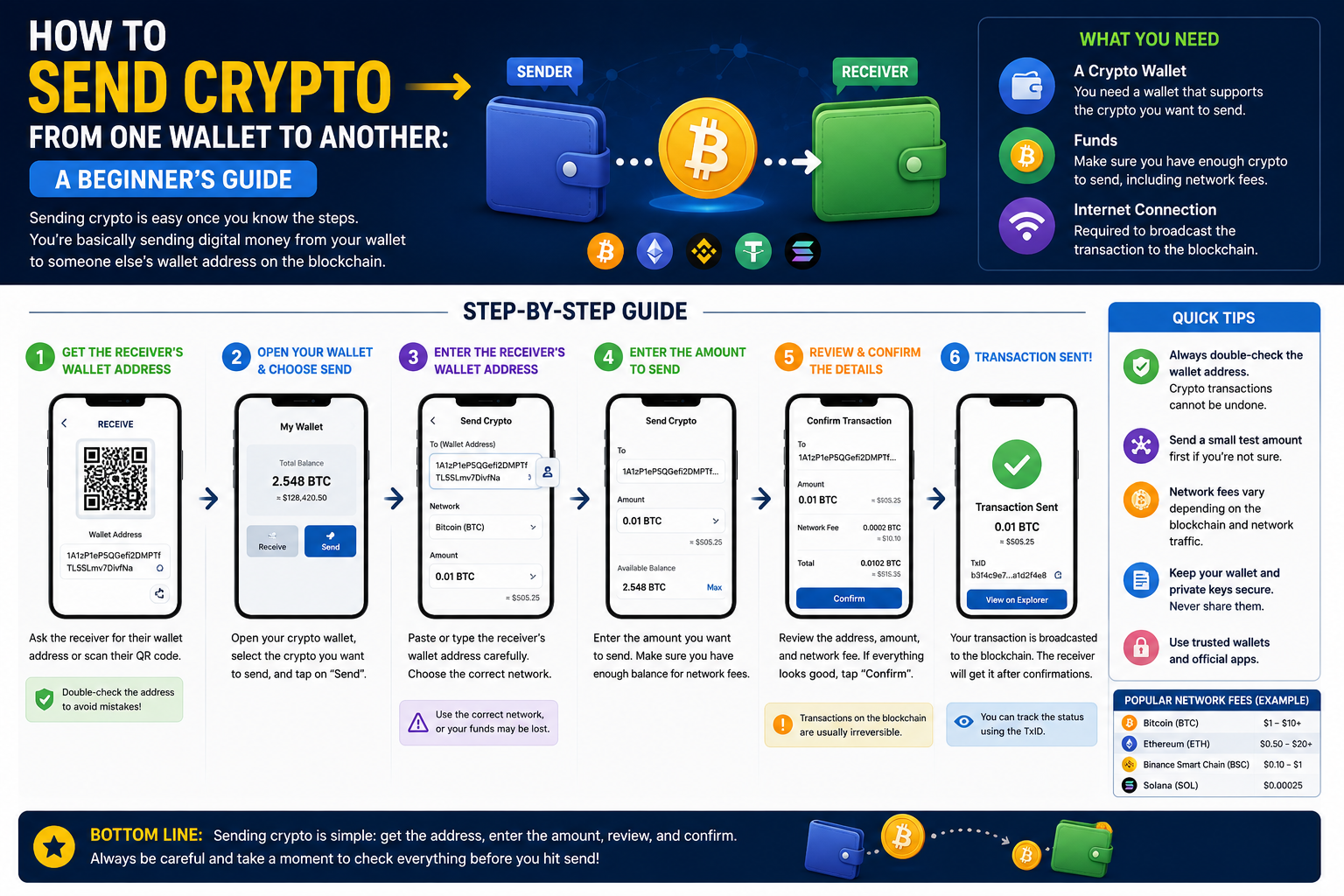
How to Send Crypto From One Wallet to Another: A Beginner’s Guide
Sending cryptocurrency from one wallet to another may look complicated when you are doing it for the first time. However, the basic process is simple once you understand wallet addresses, networks, transaction fees, and confirmations.
Whether you receive crypto from a faucet, buy cryptocurrency, or already have crypto in a wallet, knowing how to send it safely is an important skill.
This guide explains the process in simple language so beginners can understand how crypto transfers work and avoid common mistakes.
What Does It Mean to Send Crypto?
Sending crypto means transferring cryptocurrency from one blockchain address to another.
For example, you may have Bitcoin in one wallet and want to send some of it to another Bitcoin wallet. You enter the recipient's wallet address, choose the amount, check the network and fee, and confirm the transaction.
Unlike a traditional bank transfer, cryptocurrency transactions are usually processed by a blockchain network rather than a bank.
Once a transaction is confirmed on the blockchain, it generally cannot simply be reversed.
What Do You Need Before Sending Crypto?
Before sending cryptocurrency, you normally need:
A crypto wallet containing funds
The recipient's correct wallet address
The correct cryptocurrency
The correct blockchain network
Enough balance to cover the transaction fee
Access to your wallet password, PIN, or confirmation method
Always make sure you know exactly which cryptocurrency you are sending and which network the recipient expects.
Step 1: Open Your Crypto Wallet
First, open the wallet where your cryptocurrency is stored.
Depending on the wallet, you may need to unlock it with a password, PIN, biometric authentication, or another security method.
Find the Send option.
Different wallets may use slightly different names, such as:
Send
Transfer
Withdraw
Pay
The function is generally the same: it allows you to transfer cryptocurrency to another blockchain address.
Step 2: Get the Recipient's Wallet Address
The person receiving the crypto needs to provide a wallet address.
A wallet address is a long string of letters and numbers that identifies a blockchain destination.
For example, a Bitcoin address and an Ethereum address are not necessarily interchangeable.
Never manually type a long wallet address if you can avoid it. Copy and paste the address or use a trusted QR code.
After pasting the address, check it carefully.
Step 3: Select the Correct Network
This is one of the most important parts of a crypto transfer.
Some cryptocurrencies can exist on multiple blockchain networks. Sending through the wrong network can result in funds becoming difficult or impossible to recover.
For example, a platform may offer several network choices for the same token.
Before confirming a transfer, make sure:
The sending network = the receiving network
If the recipient specifically says to send through a particular network, use that network.
If you are unsure, stop the transaction and check the receiving wallet or platform's deposit instructions.
Step 4: Enter the Amount
Enter the amount of cryptocurrency you want to send.
Pay attention to the unit displayed by the wallet.
For example, a wallet might display:
BTC
ETH
USDT
Another supported cryptocurrency
Also check whether the wallet deducts the transaction fee from the amount you are sending or charges it separately.
Step 5: Check the Transaction Fee
Crypto transactions usually require a network fee.
The fee helps compensate the network for processing and confirming the transaction.
The amount of the fee can change depending on:
The blockchain
Network activity
Transaction size
Current network conditions
Wallet settings
A higher fee does not always mean that you should simply choose the highest possible option. Check what your wallet recommends and understand the fee before confirming.
Step 6: Review Everything Before Confirming
Before pressing the final Send button, carefully review:
Cryptocurrency
Amount
Recipient address
Network
Transaction fee
Estimated amount received
This is the most important safety step.
If the address or network is wrong, correcting the mistake after the transaction is confirmed may not be possible.
Step 7: Confirm the Transaction
After checking everything, confirm the transaction.
Your wallet may ask you to enter:
PIN
Password
Two-factor authentication code
Email confirmation
Biometric verification
Once confirmed, the wallet will broadcast the transaction to the blockchain.
Step 8: Wait for Blockchain Confirmation
After sending, the transaction may initially appear as Pending.
This does not necessarily mean something is wrong.
The transaction needs to be processed by the blockchain network. Depending on the cryptocurrency and network conditions, confirmation can take different amounts of time.
You may receive a transaction ID, also called a TXID or transaction hash.
This ID can be used to check the transaction status on a compatible blockchain explorer.
What Is a Transaction ID?
A transaction ID is a unique identifier associated with a blockchain transaction.
If your wallet provides a TXID, you can use it to track the transaction.
A blockchain explorer may show information such as:
Transaction status
Amount transferred
Sending address
Receiving address
Network fee
Number of confirmations
This can be useful when a recipient has not received the crypto yet.
Common Mistakes Beginners Should Avoid
Crypto transfers are usually straightforward, but beginners often make avoidable mistakes.
1. Sending to the Wrong Address
Always verify the recipient address before confirming.
2. Choosing the Wrong Network
Make sure the receiving platform or wallet supports the exact network you are using.
3. Sending the Wrong Cryptocurrency
Check the asset name carefully before sending.
4. Forgetting the Network Fee
Make sure your wallet has enough balance to cover the transaction fee.
5. Sending Everything
If you may need the wallet later, remember that you may need some balance for future transactions and fees.
6. Trusting a Random Message
Never send crypto simply because someone contacted you and asked for payment.
Be especially careful with messages promising guaranteed profits, rewards, giveaways, or account recovery.
Should Beginners Send a Small Test Transaction?
When sending a significant amount to a new wallet or platform for the first time, using a small test transaction can be a sensible safety practice.
First confirm that the small amount arrives correctly.
Then, if everything is correct, you can consider sending the remaining amount.
This can help reduce the risk of losing a large amount because of an incorrect address or network selection.
Can a Crypto Transaction Be Cancelled?
In many cases, cryptocurrency transactions cannot be reversed after they have been confirmed on the blockchain.
Some wallets may allow limited options while a transaction is still pending, but this depends on the cryptocurrency and wallet.
For this reason, always verify the transaction details before confirming it.
Is Sending Crypto Safe?
Sending cryptocurrency can be safe when you follow basic security practices.
The most important rules are:
Verify the recipient address.
Verify the network.
Verify the cryptocurrency.
Check the amount.
Review the transaction fee.
Never share your private key or recovery phrase.
Do not send crypto to strangers because of promises of guaranteed returns.
Your wallet's seed phrase or recovery phrase should never be shared with anyone.
Anyone who obtains access to your recovery phrase may be able to control the funds associated with that wallet.
Final Thoughts
Sending cryptocurrency from one wallet to another becomes much easier once you understand the basic steps.
The process is generally:
Open wallet → Choose Send → Enter recipient address → Select correct network → Enter amount → Check fee → Verify everything → Confirm → Wait for blockchain confirmation.
The most important thing for beginners is not speed but accuracy. Take a few extra seconds to check the wallet address, cryptocurrency, and network before confirming a transaction.
A careful transfer can help you avoid some of the most common and costly crypto mistakes.