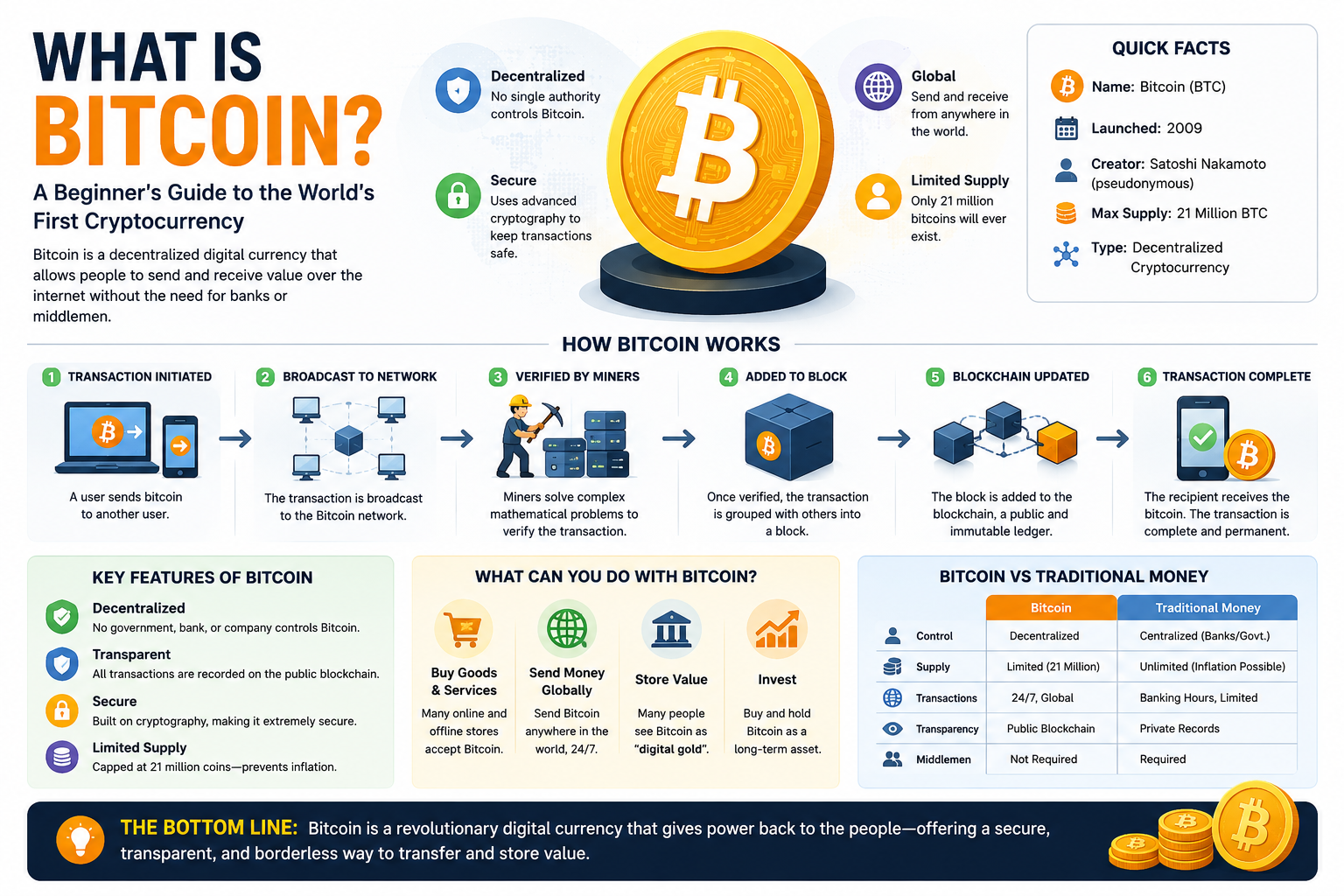
What Is Bitcoin? A Beginner's Guide to the World's First Cryptocurrency
Bitcoin is the cryptocurrency that introduced many people to the idea of digital money without relying on a traditional bank.
Since its launch, Bitcoin has become one of the most widely known digital assets in the world. But if you are new to cryptocurrency, you may still wonder how Bitcoin works and why it is important.
This beginner's guide explains the basics in simple terms.
### What Is Bitcoin?
Bitcoin is a digital cryptocurrency that operates on a decentralized blockchain network.
Unlike traditional currencies that are generally issued and managed by central monetary authorities, Bitcoin operates through a network of computers following a shared set of rules.
Bitcoin can be used to send and receive value digitally.
### Who Created Bitcoin?
Bitcoin was introduced in 2008 through a whitepaper published under the name **Satoshi Nakamoto**.
The Bitcoin network launched in 2009.
The real-world identity of Satoshi Nakamoto has never been conclusively established.
### How Does Bitcoin Work?
Bitcoin transactions are recorded on the Bitcoin blockchain.
When someone sends Bitcoin, the transaction is broadcast to the network.
Network participants verify the transaction according to Bitcoin's rules.
Valid transactions can then be included in blocks and added to the blockchain.
This creates a public record of Bitcoin transactions.
### What Is the Bitcoin Blockchain?
The Bitcoin blockchain is a distributed ledger containing the history of Bitcoin transactions.
Copies of the blockchain are maintained across many computers participating in the network.
This distributed structure helps the network operate without relying on one central database.
### What Is Bitcoin Mining?
Bitcoin uses a consensus system called **Proof of Work**.
Bitcoin miners use specialized computing equipment to perform computational work.
Miners compete to add new blocks to the blockchain.
Successful miners can receive Bitcoin rewards and transaction fees according to the network's rules.
Mining also plays an important role in helping secure the Bitcoin network.
### Why Does Bitcoin Have a Limited Supply?
One of Bitcoin's well-known characteristics is its limited maximum supply.
The Bitcoin protocol specifies a maximum supply of approximately **21 million BTC**.
New Bitcoin enters circulation through the network's issuance process, including mining rewards.
Over time, the rate at which new Bitcoin is created decreases according to the protocol.
### What Is a Bitcoin Wallet?
A Bitcoin wallet is a tool used to manage Bitcoin.
It allows users to receive Bitcoin, send Bitcoin and monitor their holdings.
The Bitcoin itself is recorded on the blockchain.
The wallet manages the cryptographic credentials needed to control Bitcoin associated with particular addresses.
### Bitcoin Address
A Bitcoin address can be used to receive Bitcoin.
When someone wants to send Bitcoin to you, you can provide an appropriate receiving address from your wallet.
Always verify the address before sending funds.
Blockchain transactions can be difficult or impossible to reverse once confirmed.
### Is Bitcoin Anonymous?
Bitcoin is not completely anonymous.
Bitcoin transactions are recorded publicly on the blockchain.
People can often see transaction information such as addresses and amounts.
However, a Bitcoin address does not automatically display the real-world identity of its owner.
For this reason, Bitcoin is often described as pseudonymous rather than fully anonymous.
### Why Do Bitcoin Transactions Have Fees?
Bitcoin transactions can include network fees.
Fees help incentivize miners to process transactions and contribute to network security.
The required fee can vary depending on network conditions and transaction characteristics.
When the network is busy, users may need to pay more to have transactions processed promptly.
### Can Bitcoin Be Divided?
Yes.
You do not need to buy one whole Bitcoin.
Bitcoin can be divided into very small units.
The smallest commonly used unit is called a **satoshi**, named after Bitcoin's creator.
One Bitcoin equals 100,000,000 satoshis.
This allows users to transact with small amounts of Bitcoin.
### Why Do People Use Bitcoin?
People use Bitcoin for different reasons.
Some people use it to transfer value.
Others hold it as a digital asset or explore it as part of the broader cryptocurrency ecosystem.
Bitcoin can also be used as a way to learn about blockchain technology, digital wallets and decentralized networks.
However, Bitcoin's price can be highly volatile, so using or holding it involves financial risk.
### Bitcoin and Traditional Money
Bitcoin differs from traditional money in several ways.
Traditional currencies are generally managed through centralized financial systems.
Bitcoin operates through a decentralized network and predefined protocol rules.
Bitcoin can also be transferred directly between compatible wallets without requiring a traditional bank to process the blockchain transaction.
However, exchanges and other services may still be used when converting Bitcoin to or from traditional currencies.
### Bitcoin vs Other Cryptocurrencies
Bitcoin was the first successful cryptocurrency and remains distinct from many newer crypto projects.
Other cryptocurrencies may offer different features, consensus systems, transaction speeds or applications.
For example, some blockchain networks focus heavily on smart contracts and decentralized applications.
Bitcoin's primary design remains focused on decentralized digital money and a secure blockchain-based payment system.
### Is Bitcoin Safe?
Bitcoin's underlying network has strong security properties, but using Bitcoin safely also depends on the user.
Common risks include:
* Losing wallet recovery information
* Sending funds to the wrong address
* Falling for phishing scams
* Using fake wallet applications
* Sharing private keys
* Sending cryptocurrency to fraudulent services
Good security practices are therefore essential.
### Should Beginners Buy Bitcoin?
Whether someone should buy Bitcoin is a personal financial decision.
Bitcoin's price can change substantially, and past performance does not guarantee future results.
Beginners should first learn how wallets, transactions, fees and security work before risking money they cannot afford to lose.
Learning about cryptocurrency does not require immediately buying it.
### Final Thoughts
Bitcoin introduced a new approach to digital money based on cryptography, blockchain technology and a decentralized network.
Understanding Bitcoin gives beginners a strong foundation for learning about other cryptocurrencies and blockchain applications.
If you are starting your crypto journey, focus first on understanding wallets, transaction fees, security and blockchain basics. Once you understand these concepts, Bitcoin and the wider cryptocurrency ecosystem become much easier to understand.
Enjoyed this article?