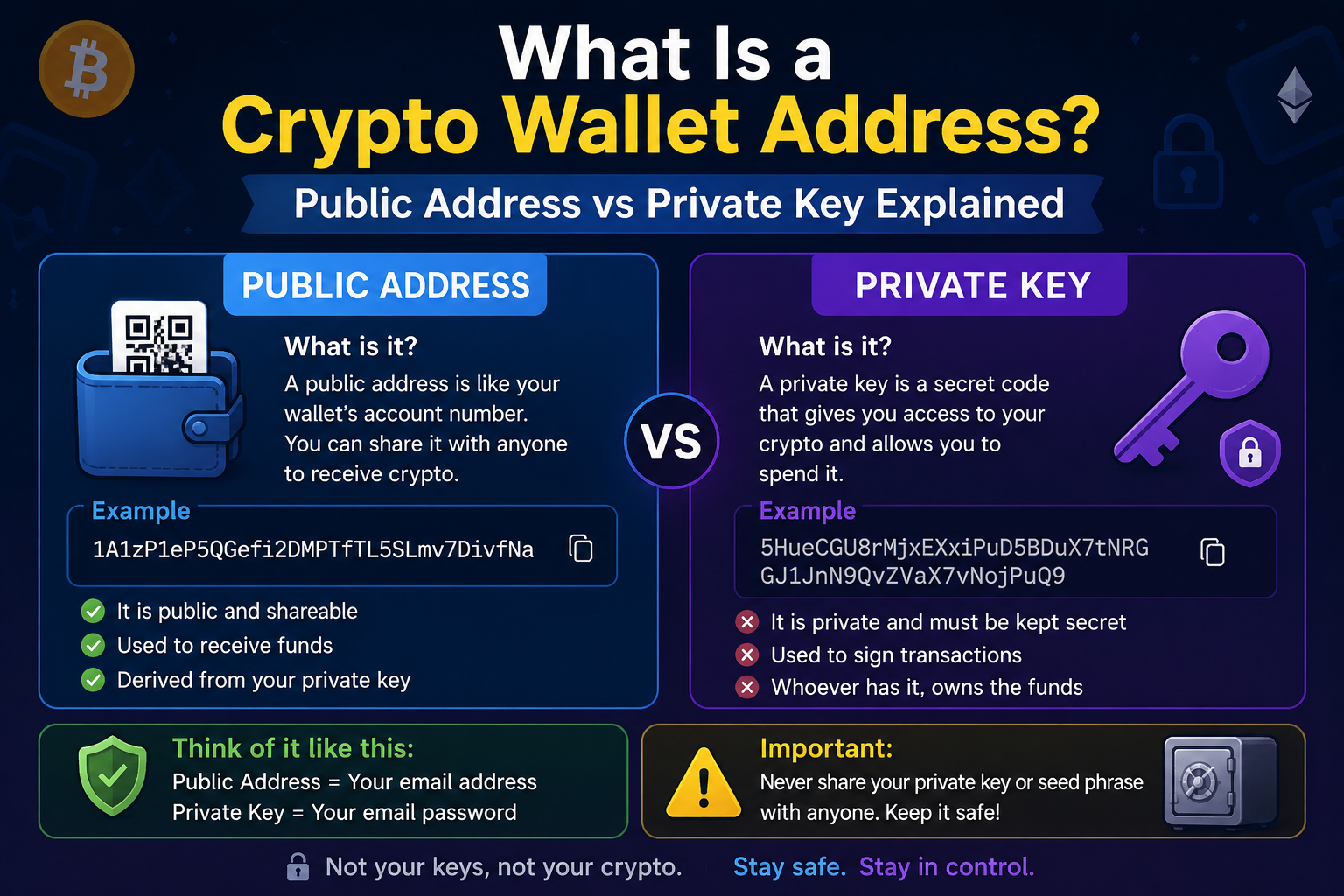
What Is a Crypto Wallet Address? Public Address vs Private Key Explained
If you are new to cryptocurrency, you may have seen a long combination of letters and numbers called a crypto wallet address.
You may need a wallet address when receiving cryptocurrency from an exchange, another person, or a crypto faucet.
At first, these addresses can look confusing. It is also easy to confuse a public wallet address with a private key or recovery phrase.
In this guide, we will explain what a crypto wallet address is, how it works, and what beginners should know before using one.
What Is a Crypto Wallet Address?
A crypto wallet address is a unique identifier that can be used to receive cryptocurrency on a blockchain network.
It is usually made up of letters and numbers, although the format depends on the cryptocurrency and network.
When someone wants to send cryptocurrency to you, you can provide the appropriate receiving address.
The blockchain then records the transaction involving that address.
A simple way to think about it is:
Wallet address = destination for receiving cryptocurrency
However, a wallet address is not the same thing as your private key.
Can You Share Your Crypto Wallet Address?
Generally, yes.
A public receiving address is designed to be shared when you want someone to send cryptocurrency to you.
For example, if a crypto faucet asks for your wallet address so it can send your reward, you would normally provide the appropriate receiving address.
However, you should still verify the address before submitting it.
A mistake in the address or network can cause a transaction to go to the wrong destination.
What Is a Private Key?
A private key is secret information used to authorize transactions and prove control over cryptocurrency associated with a wallet.
Unlike a public wallet address, a private key should never be shared.
You should treat your private key like highly sensitive security information.
If someone gains access to your private key, they may be able to control the cryptocurrency associated with it.
Remember:
Public address → Can be shared for receiving
Private key → Must remain secret
What Is a Recovery Phrase?
A recovery phrase is another important security concept.
Many self-custody wallets provide a series of words that can be used to restore access to a wallet.
The exact format depends on the wallet.
Your recovery phrase should be kept private and stored securely.
It should never be given to:
Websites
Faucet support agents
Social media accounts
Unknown applications
People offering investment help
Anyone claiming they need it to release your funds
A legitimate person sending cryptocurrency to your wallet does not need your recovery phrase.
Wallet Address vs Private Key
These two terms are often confused by beginners.
| Feature | Wallet Address | Private Key |
|---|---|---|
| Used for receiving | Yes | No |
| Can be shared | Generally yes | Never |
| Used to authorize transactions | No | Yes |
| Public information | Generally | No |
| Security sensitivity | Lower | Extremely high |
The wallet address identifies where cryptocurrency can be sent, while the private key provides control over the associated assets.
Are All Crypto Addresses the Same?
No.
Different cryptocurrencies and blockchain networks can use different address formats.
For example, addresses for Bitcoin, Ethereum-based assets, and other networks may look completely different.
Even when two assets use similar address formats, the network still matters.
This is why you should not assume that an address works simply because it looks correct.
Always check:
Cryptocurrency + Network + Address
before making a transaction.
Why Does the Network Matter?
The blockchain network determines where a transaction is processed.
Some cryptocurrencies or tokens can be transferred using more than one network.
If a platform gives you a choice of networks, make sure the receiving wallet supports the network you select.
Using an unsupported or incompatible network can result in funds becoming difficult or impossible to recover.
For beginners, this is one of the most important cryptocurrency transaction rules.
How to Find Your Wallet Address
The exact steps depend on the wallet you use, but the process is usually similar.
Step 1: Open Your Wallet
Open your cryptocurrency wallet application.
Step 2: Select the Cryptocurrency
Choose the cryptocurrency you want to receive.
Step 3: Select "Receive"
Look for a button such as:
Receive, Deposit, or Receive Crypto.
Step 4: Select the Network
If the wallet supports multiple networks, choose the correct one.
Step 5: Copy Your Address
Copy the displayed wallet address.
You can then provide it to the person or platform sending you cryptocurrency.
Should You Type a Wallet Address Manually?
It is usually safer to copy and paste a wallet address rather than typing it manually.
Crypto addresses can be long and difficult to type accurately.
After copying an address, check it before confirming the transaction.
For important transactions, consider verifying the address using a trusted method instead of relying only on a copied message.
Can You Have Multiple Wallet Addresses?
Yes.
Depending on the wallet and cryptocurrency, you may have multiple receiving addresses.
Some wallets generate a new address for certain transactions or allow you to create multiple addresses.
This does not necessarily mean that your cryptocurrency is stored separately in the way files are stored in folders.
The exact behavior depends on the wallet and blockchain.
What Happens When Someone Sends Crypto to Your Address?
When cryptocurrency is sent to your address, a transaction is broadcast to the relevant blockchain network.
The network processes the transaction according to its rules.
After the transaction receives the required confirmations, the funds should become available according to the wallet and network.
You may be able to track the transaction using a blockchain explorer if you have the transaction ID.
What Is a Transaction ID?
A transaction ID, often called a TXID or transaction hash, is a unique identifier associated with a blockchain transaction.
It can help you check transaction details such as:
Status
Amount
Receiving address
Sending address
Confirmations
Transaction time
If a faucet or exchange provides a TXID after a withdrawal, you can often use the appropriate blockchain explorer to check the transaction.
What If You Give Someone the Wrong Address?
If you provide the wrong address before a transaction is sent, you may be able to correct it simply by giving the sender the correct address.
However, if cryptocurrency has already been sent to an incorrect address and the transaction has been confirmed, recovering the funds may be extremely difficult or impossible.
That is why checking the address before confirming a transaction is so important.
How to Keep Your Wallet Address Safe
A public wallet address does not require the same secrecy as a private key.
However, you should still be careful about where you publish it.
A public address may allow people to view its blockchain activity using a blockchain explorer.
If privacy is important to you, understand that blockchain transactions can often be publicly visible.
Common Wallet Address Mistakes
Mistake 1: Using the Wrong Cryptocurrency
Make sure the address is intended for the cryptocurrency you are receiving.
Mistake 2: Choosing the Wrong Network
Check that both sides support the same network.
Mistake 3: Sharing the Private Key Instead
Only provide the public receiving address when someone asks where to send cryptocurrency.
Mistake 4: Ignoring the Transaction Fee
Check the sender's required network or withdrawal fee before confirming a transaction.
Mistake 5: Trusting a Random Website
Do not enter private wallet information into unknown websites.
Final Thoughts
A crypto wallet address is simply an important piece of information used to receive cryptocurrency.
It can generally be shared when someone needs to send you crypto, but it should never be confused with your private key or recovery phrase.
The easiest rule to remember is:
Address = receiving
Private key = control
Recovery phrase = wallet backup
Before receiving or sending cryptocurrency, always verify the cryptocurrency, network, and wallet address.
Taking a few seconds to check these details can help prevent costly mistakes and make your cryptocurrency experience much safer.