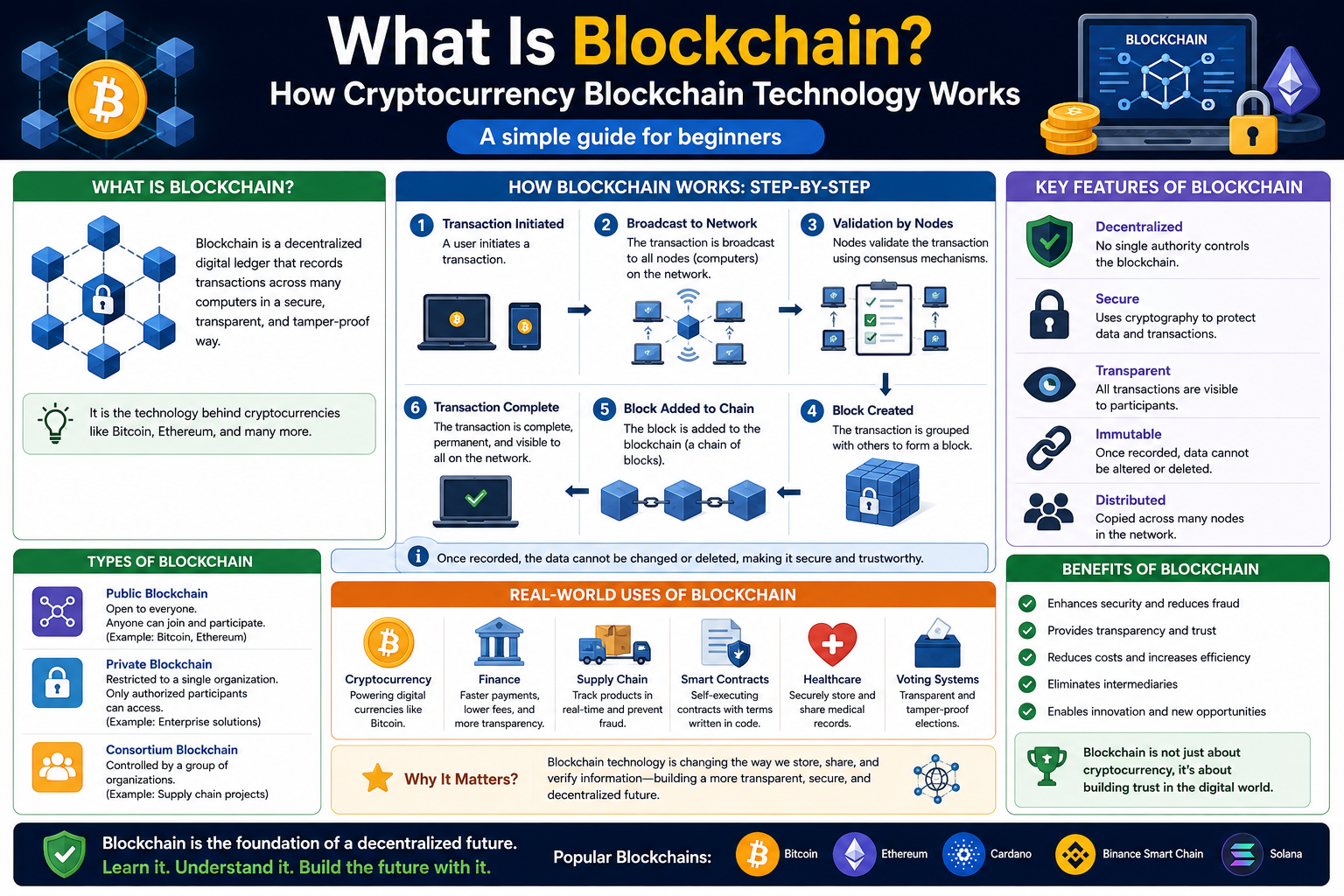
What Is Blockchain? How Cryptocurrency Blockchain Technology Works
If you are learning about cryptocurrency, you will often hear the word **blockchain**. Bitcoin, many other cryptocurrencies and numerous blockchain applications use this technology.
But what exactly is a blockchain, and how does it work?
In simple terms, a blockchain is a digital record system that allows transactions and other information to be recorded across a distributed network.
## What Is a Blockchain?
A blockchain is a type of digital ledger.
A ledger is simply a record of transactions or information.
Traditional financial systems usually rely on centralized organizations to maintain their records. A blockchain can distribute its record across many computers participating in the network.
This makes the system different from a traditional database.
## Why Is It Called a Blockchain?
The name comes from the way information is organized.
Transactions can be grouped into **blocks**.
These blocks are then connected together in a sequence, creating a chain of blocks.
Hence the term:
**Block + Chain = Blockchain**
Each block can contain transaction information along with data that connects it to previous blocks.
## How Does a Blockchain Transaction Work?
Suppose you want to send cryptocurrency to another person.
The basic process looks something like this:
1. You create a transaction.
2. Your wallet signs the transaction.
3. The transaction is broadcast to the network.
4. Network participants verify it.
5. The transaction is included in a block.
6. The block is added to the blockchain.
7. The transaction receives confirmation.
The exact process depends on the blockchain being used.
## What Are Blockchain Nodes?
A blockchain network can contain many computers called **nodes**.
Nodes can communicate with each other and maintain information about the blockchain.
Depending on the network and type of node, a node may verify transactions, store blockchain data or participate in reaching agreement about the state of the network.
This distributed structure is one of the important characteristics of blockchain technology.
## What Does Decentralized Mean?
You may also hear that cryptocurrency is decentralized.
In a decentralized network, control and verification are distributed among network participants rather than being managed entirely by one central organization.
However, decentralization can vary significantly between different blockchain projects.
Not every blockchain has the same level of decentralization.
## How Are Transactions Verified?
Blockchain networks need a method for agreeing on which transactions are valid and what information should be added to the ledger.
This is handled through a **consensus mechanism**.
Different blockchains use different mechanisms.
For example, some networks use Proof of Work, while others use Proof of Stake.
The technical details differ, but the general goal is to help the network agree on the valid state of the blockchain.
## What Is Proof of Work?
Proof of Work is a consensus mechanism used by Bitcoin.
Participants called miners use computing resources to compete to add new blocks to the blockchain.
The process requires computational work, which helps protect the network from certain types of attacks.
Bitcoin is the best-known example of a blockchain using Proof of Work.
## What Is Proof of Stake?
Proof of Stake uses a different approach.
Instead of relying primarily on computational mining, participants can lock or "stake" cryptocurrency according to the rules of the network.
Validators are then involved in processing transactions and helping maintain the blockchain.
The exact rules vary between Proof-of-Stake networks.
## Are Blockchain Transactions Private?
Blockchain transactions are not necessarily anonymous.
Many public blockchains allow transaction information to be viewed publicly.
For example, people may be able to see:
* Wallet addresses
* Transaction amounts
* Transaction times
* Transaction history
However, a blockchain address does not necessarily display the real-world identity of the person controlling it.
This is one reason blockchain transactions are often described as pseudonymous rather than completely anonymous.
## Can Blockchain Data Be Changed?
One important feature of many blockchains is that confirmed historical data is difficult to change.
Because blocks are connected and maintained across a network, changing historical information can require overcoming significant technical and economic protections.
However, "immutable" does not mean that every blockchain is absolutely impossible to change under every circumstance.
The security model depends on the specific blockchain.
## Blockchain and Cryptocurrency
Cryptocurrency is one of the most well-known applications of blockchain technology.
A cryptocurrency blockchain can record:
* Transfers
* Balances
* Transaction history
* Network activity
This allows users to transfer digital assets without relying entirely on a traditional centralized payment database.
## Blockchain Beyond Cryptocurrency
Blockchain technology is not limited to digital currencies.
Blockchain-based systems can also be used in areas such as:
* Digital assets
* Tokenized ownership
* Decentralized applications
* Supply-chain systems
* Digital identity
* Smart contracts
* Decentralized finance
The usefulness of blockchain depends on the specific problem a project is trying to solve.
## What Are Smart Contracts?
Smart contracts are programs that run according to rules on a blockchain network.
They can automatically perform actions when predefined conditions are met.
For example, a smart contract could be designed to exchange one digital asset for another according to programmed rules.
Smart contracts are an important part of many blockchain ecosystems.
## Is Blockchain the Same as Cryptocurrency?
No.
Blockchain is the underlying technology used by many cryptocurrencies, but blockchain and cryptocurrency are not the same thing.
A blockchain is a technology for recording and processing information.
A cryptocurrency is a digital asset that can operate on a blockchain network.
You can think of blockchain as the infrastructure, while cryptocurrency is one of the applications that can use that infrastructure.
## Why Is Blockchain Important?
Blockchain introduced a way for multiple participants to maintain a shared digital record without relying entirely on a single central database.
For cryptocurrency users, this technology makes it possible to verify transactions and maintain a shared record of ownership.
However, blockchain technology also has limitations, including scalability, transaction costs, energy requirements for some consensus systems and technical complexity.
## Final Thoughts
Blockchain is one of the most important technologies behind cryptocurrency.
At its simplest, it is a distributed digital ledger where information can be organized into blocks and connected into a chain.
Understanding how blockchain works makes it much easier to understand cryptocurrency, wallets, transactions, mining, staking and other parts of the crypto ecosystem.
If you are new to crypto, learning the basics of blockchain is a useful foundation before moving on to more advanced topics.
Enjoyed this article?