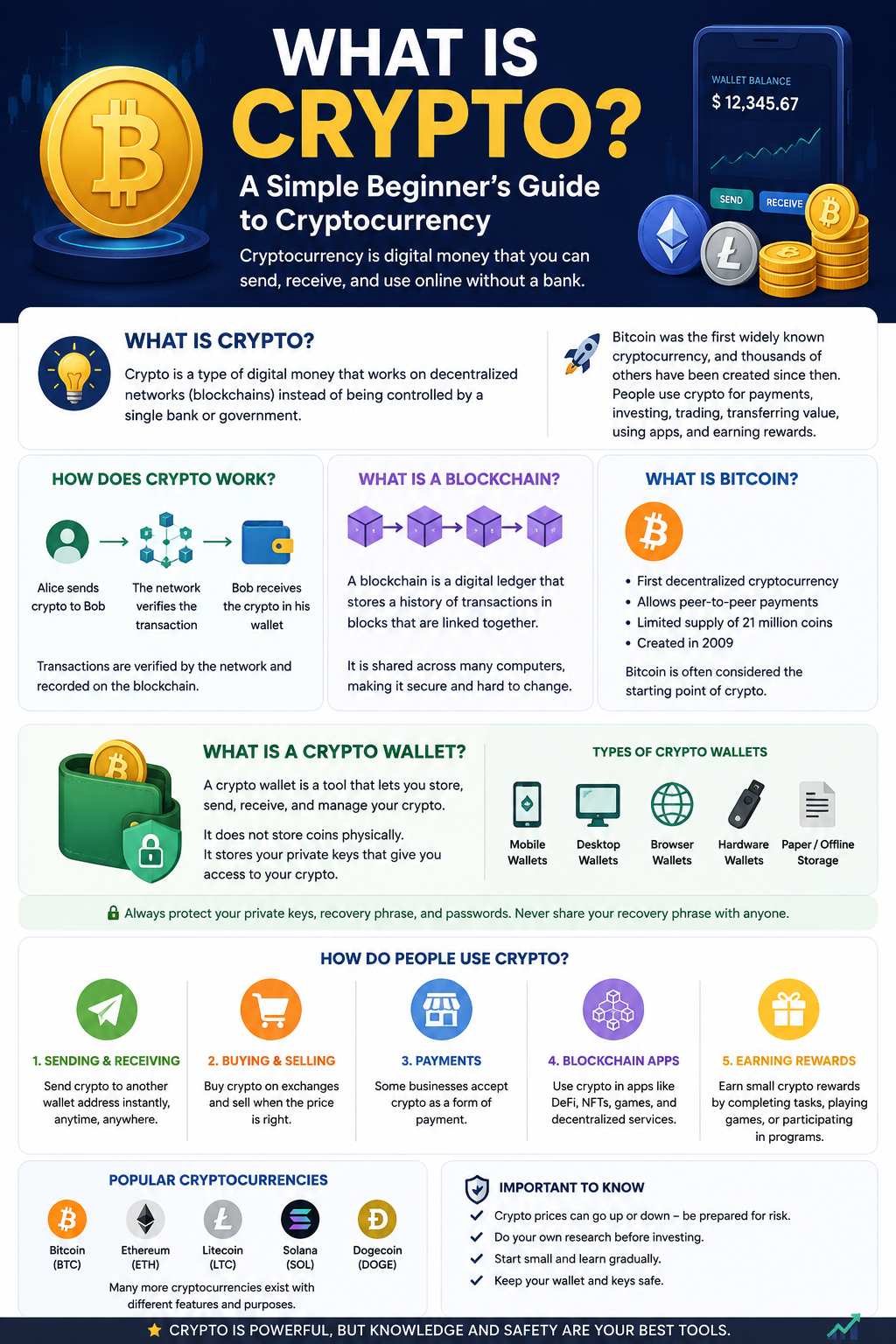
What Is Crypto? A Simple Beginner's Guide to Cryptocurrency
Cryptocurrency, often called crypto, is a type of digital money that can be used to send and receive value online. Unlike traditional currencies such as dollars, euros, or riyals, many cryptocurrencies operate on decentralized networks rather than being controlled by a single bank or government.
Bitcoin was the first widely known cryptocurrency, and thousands of other digital currencies have been created since then. Today, people use crypto for payments, investing, trading, transferring value, participating in blockchain applications, and earning digital rewards.
If you are completely new to cryptocurrency, this guide explains the basics in simple terms.
What Is Cryptocurrency?
Cryptocurrency is a form of digital asset that uses cryptography and blockchain technology to record and secure transactions.
Unlike physical cash, cryptocurrency exists digitally. Transactions are normally recorded on a blockchain, which is a distributed digital ledger maintained by a network of computers.
Some well-known cryptocurrencies include:
Bitcoin (BTC)
Ethereum (ETH)
Litecoin (LTC)
Solana (SOL)
Dogecoin (DOGE)
Each cryptocurrency can have a different purpose, technology, supply model, and network.
How Does Crypto Work?
Most cryptocurrencies rely on blockchain technology.
A blockchain is essentially a shared digital record of transactions. Instead of one central database storing everything, copies of the blockchain can be maintained across many computers participating in the network.
When a crypto transaction is made, the network verifies it according to that blockchain's rules. Once confirmed, the transaction is recorded on the blockchain.
For example, if Alice sends cryptocurrency to Bob, the network processes the transaction and records the transfer. Bob can then see the received balance through his crypto wallet.
The exact process differs between blockchain networks, but the basic idea is that transactions are verified and recorded digitally.
What Is a Blockchain?
A blockchain is the technology behind many cryptocurrencies.
Think of it as a digital ledger containing a history of transactions. Transactions are grouped into blocks, and those blocks are linked together to create a chain.
Because blockchain data is maintained across a network rather than simply stored in one central location, changing previously recorded information can be difficult.
Blockchain technology is not limited to cryptocurrency. It can also be used for applications involving digital assets, decentralized applications, smart contracts and other forms of digital record keeping.
What Is Bitcoin?
Bitcoin (BTC) is the first decentralized cryptocurrency and remains one of the best-known crypto assets.
Bitcoin allows people to transfer value over the internet without requiring a traditional bank to process every transaction.
Bitcoin has a limited maximum supply of 21 million coins. New bitcoins are introduced into circulation through the network's mining process, according to Bitcoin's protocol.
Because of its history and widespread recognition, Bitcoin is often considered an important starting point for people learning about cryptocurrency.
What Is a Crypto Wallet?
A crypto wallet is a tool that allows users to manage their cryptocurrency and interact with blockchain networks.
Despite the name, a crypto wallet does not usually store coins in the same way that a physical wallet stores cash.
Instead, wallets manage the information needed to access and authorize transactions involving digital assets.
There are different types of crypto wallets, including:
Mobile wallets
Desktop wallets
Browser wallets
Hardware wallets
Paper or other offline storage methods
Security is extremely important when using a crypto wallet. Users should protect their private keys, recovery phrases and passwords.
A recovery phrase should never be shared with someone claiming they need it to "verify" or "unlock" a wallet.
How Do People Use Cryptocurrency?
Cryptocurrency can be used in several ways, depending on the particular asset and network.
1. Sending and Receiving Crypto
Users can send cryptocurrency to another wallet address. This can be useful for transferring digital value between individuals or platforms.
2. Buying and Selling
Some people buy cryptocurrencies through exchanges or other services and later sell them.
Crypto prices can change significantly, so buying cryptocurrency involves financial risk.
3. Payments
Some businesses and online services accept certain cryptocurrencies as payment.
Availability depends on the country, business and cryptocurrency involved.
4. Blockchain Applications
Certain cryptocurrencies are connected to blockchain ecosystems that support applications such as decentralized finance, digital collectibles and other blockchain-based services.
5. Earning Crypto Rewards
Some websites and platforms provide small cryptocurrency rewards for completing activities.
Examples can include:
Crypto faucets
Surveys
Offerwalls
PTC advertisements
Shortlinks
Referral programs
Promotional campaigns
Rewards and conditions vary between platforms, so users should always understand the requirements before participating.
What Is a Crypto Faucet?
A crypto faucet is a website or platform that provides small cryptocurrency rewards for completing simple activities.
Depending on the platform, users may be asked to complete tasks such as viewing advertisements, solving a captcha, visiting pages, completing offers or simply claiming a reward at regular intervals.
Crypto faucets generally provide relatively small rewards. Their main appeal is that beginners can learn how crypto transactions and wallets work without necessarily starting with a large amount of money.
If you want to learn more about this topic, our guide What Is a Crypto Faucet? How Crypto Faucets Work can explain the process in more detail.
Can You Earn Free Crypto?
Yes, some legitimate platforms offer cryptocurrency rewards without requiring users to purchase crypto first.
However, "free crypto" does not mean that every website offering rewards is trustworthy.
Before using an earning platform, beginners should check:
How the reward system works
Minimum withdrawal requirements
Supported cryptocurrencies
Payment history and reputation
Terms and conditions
Whether personal information is being requested
Whether the platform asks for unnecessary wallet access
Users should also be cautious about websites promising unusually large rewards for very little work.
If an offer sounds unrealistic, it deserves extra scrutiny.
Is Cryptocurrency Safe?
Cryptocurrency itself is based on cryptographic and blockchain technologies, but using crypto safely depends heavily on the user, wallet, platform and security practices involved.
Some common risks include:
Losing access to a wallet
Sending crypto to the wrong address
Phishing websites
Fake investment schemes
Account theft
Fraudulent giveaways
Highly volatile prices
Untrusted earning platforms
A blockchain transaction can be difficult or impossible to reverse once it has been confirmed. This is why checking wallet addresses and transaction details before sending crypto is important.
How Can Beginners Stay Safe With Crypto?
If you are new to cryptocurrency, start slowly.
Protect Your Recovery Phrase
Never share your wallet's recovery phrase with another person. Someone who obtains it may be able to access the assets associated with the wallet.
Use Strong Account Security
Use strong, unique passwords and enable two-factor authentication where available.
Check Website Addresses
Scammers often create websites that look similar to legitimate services. Always check that you are using the correct website before entering login information or wallet details.
Never Send Crypto Because Someone Promises a Larger Return
A common scam involves asking users to send cryptocurrency first with a promise that they will receive more crypto in return.
Be extremely cautious with these offers.
Start Small
Beginners do not need to risk a large amount of money to learn how cryptocurrency works.
Learning how wallets, addresses, transactions and blockchain confirmations work can be more valuable than immediately making a large investment.
What Is the Difference Between Crypto and Traditional Money?
Traditional currencies such as USD, EUR and SAR are issued and regulated through governments and central banking systems.
Cryptocurrencies operate differently. Many use decentralized blockchain networks, although the structure and governance of each cryptocurrency can vary.
Traditional money is commonly held in bank accounts or physical form, while cryptocurrency is controlled through blockchain addresses and cryptographic keys.
The two systems can also interact. People can use exchanges and other services to convert between traditional currencies and cryptocurrencies, where available.
Why Do People Use Cryptocurrency?
People have different reasons for using crypto.
Some are interested in blockchain technology. Others use cryptocurrency for transferring digital value, accessing blockchain applications, earning rewards or exploring digital assets.
Some people also view certain cryptocurrencies as investment assets.
However, cryptocurrency prices can be highly volatile. A cryptocurrency that increases in value can also lose significant value, so users should understand the risks before committing money.
What Should a Crypto Beginner Learn First?
A beginner does not need to understand every technical detail immediately.
A good learning path is:
Understand what cryptocurrency is.
Learn the basics of blockchain technology.
Understand wallets and wallet addresses.
Learn how crypto transactions work.
Learn basic security and scam prevention.
Understand how crypto prices and fees work.
Explore earning methods such as faucets only after understanding the basics.
Research any platform before using it.
This approach can help beginners make better decisions and avoid common mistakes.
Frequently Asked Questions
Is crypto real money?
Cryptocurrency is a digital asset that can be used as a form of digital value. Whether it can be used directly as payment depends on the cryptocurrency, service and location.
Is cryptocurrency legal?
The legal and regulatory treatment of cryptocurrency differs between countries. Users should check the rules that apply in their own location.
Can I start crypto with no money?
Some platforms offer free crypto rewards through faucets, educational programs, promotions or other activities. However, rewards are usually small and every platform should be checked carefully before use.
Is Bitcoin the same as cryptocurrency?
No. Bitcoin is one cryptocurrency. The term cryptocurrency refers to a much broader category of digital assets.
Do I need a crypto wallet?
If you want to hold or receive cryptocurrency directly, you will generally need a wallet or another service that provides wallet functionality.
Can crypto make me rich?
There is no guaranteed way to become rich through cryptocurrency. Crypto prices can be highly volatile, and anyone promising guaranteed profits should be treated with caution.
Final Thoughts
Cryptocurrency is a growing area of digital technology that combines digital assets, cryptography and blockchain networks.
For beginners, the most important first step is not trying to make quick profits. It is understanding how cryptocurrency works, how wallets and transactions work, and how to protect yourself from scams.
Once you understand these basics, you can explore different areas of crypto, including Bitcoin, blockchain applications, crypto wallets and legitimate earning opportunities.
Our upcoming guides can help you learn these topics step by step, including how to earn free crypto online, how crypto faucets work, and the different ways beginners can explore cryptocurrency rewards.